A part of the Memory Experience
Keep what matters, and see what stays.
Converse or go through an experience, and later — hours or weeks, you choose — see what you remember.
What the Memory Experience is
Two things that belong together. A memory game that helps you keep what you read, and places to keep what matters — the day of a wedding, the story of someone you lost, the people and places in a family's history.
The places hold the stories; the game is how you hold on to them. Everything is private until you choose to share it, and guests can join in from their phones.
You're in the capsule when something goes wrong, with Houston on the radio and the news arriving one message at a time — then find out what stayed with you.

The Memory Game
Most of what we read is gone within days. The game is built on the two things that make it stay: meeting it as a story rather than a list, and being asked about it again just as it starts to slip.
- Study it as a story. Talk your way through a conversation with someone from history, or live through a moment as it happened, one piece at a time.
- Later, find out what stayed. Pick when your test unlocks — five hours, a day, three days, a week or two weeks — and it asks about exactly what you read.
- Make your own. Write a conversation or an experience about anything you want to remember, and send it to a friend to see how they do.
Talk with Maria Skłodowska-Curie — Marie Curie — about her discoveries in physics and chemistry.


A conversation reveals itself a line at a time, so each fact arrives attached to a moment in the story.


The test asks about what you studied once enough time has passed that remembering it takes real effort — which is what makes it stick.
Memory Match
The other kind of remembering, and a much shorter one. Turn over two cards at a time and put each face to its name — everything on the board is something publicly shared in the library, so a pair you find is a page you can go and read.
- Names against faces. Not two copies of the same picture: one half of each pair is a portrait and the other is who it is, which is a thing worth having learned.
- Six, eight or twelve pairs. The board is dealt from whatever is in the library that day, so it is never quite the same twice.
- Nothing to set up, nothing kept. No account, no score to chase. Match them, then open the ones you did not recognise.
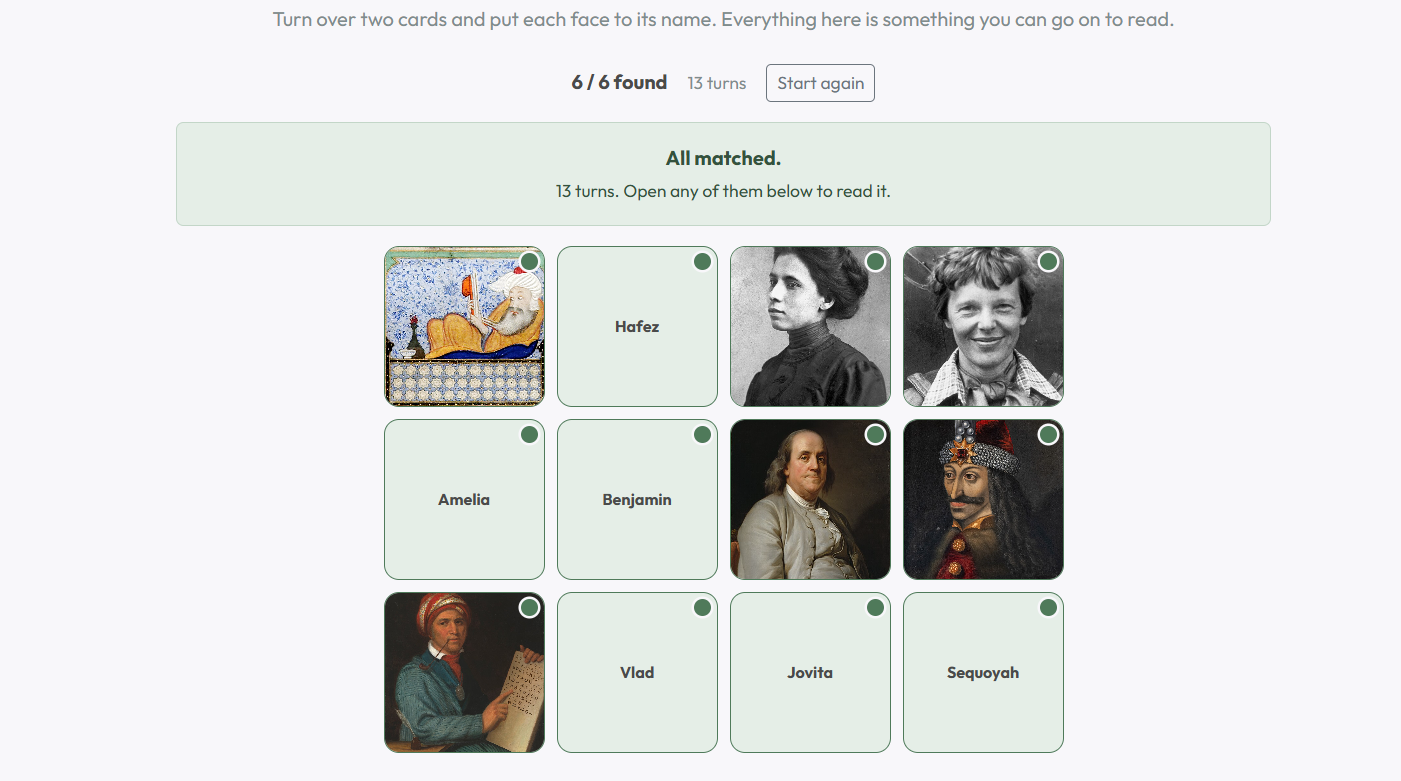
A finished board. Each matched pair becomes a link to that subject — the reward for putting a face to a name is being able to go and read about them.
Occasions
A page for the day that everyone you invite can open: when and where, what happens when, and who it is about. Guests leave messages and photos from their seats, and the page keeps them afterward.
- RSVP on the page. Guests answer yes, no or maybe, say how many are coming and leave you a note. You see every answer, and can choose whether guests see who else is coming.
- The people it is about. Link each person to their own page, and their story plays alongside the day — how the couple met, told in order.
- A guest wall and a gallery. Messages and photos arrive as they are posted, and the whole album opens as a gallery.
- Show it on a TV. One button turns the page into a slideshow of photos, stories and guest messages for a screen at the reception.
See a real wedding page — the schedule, the people, and the photos and messages guests left from their phones.
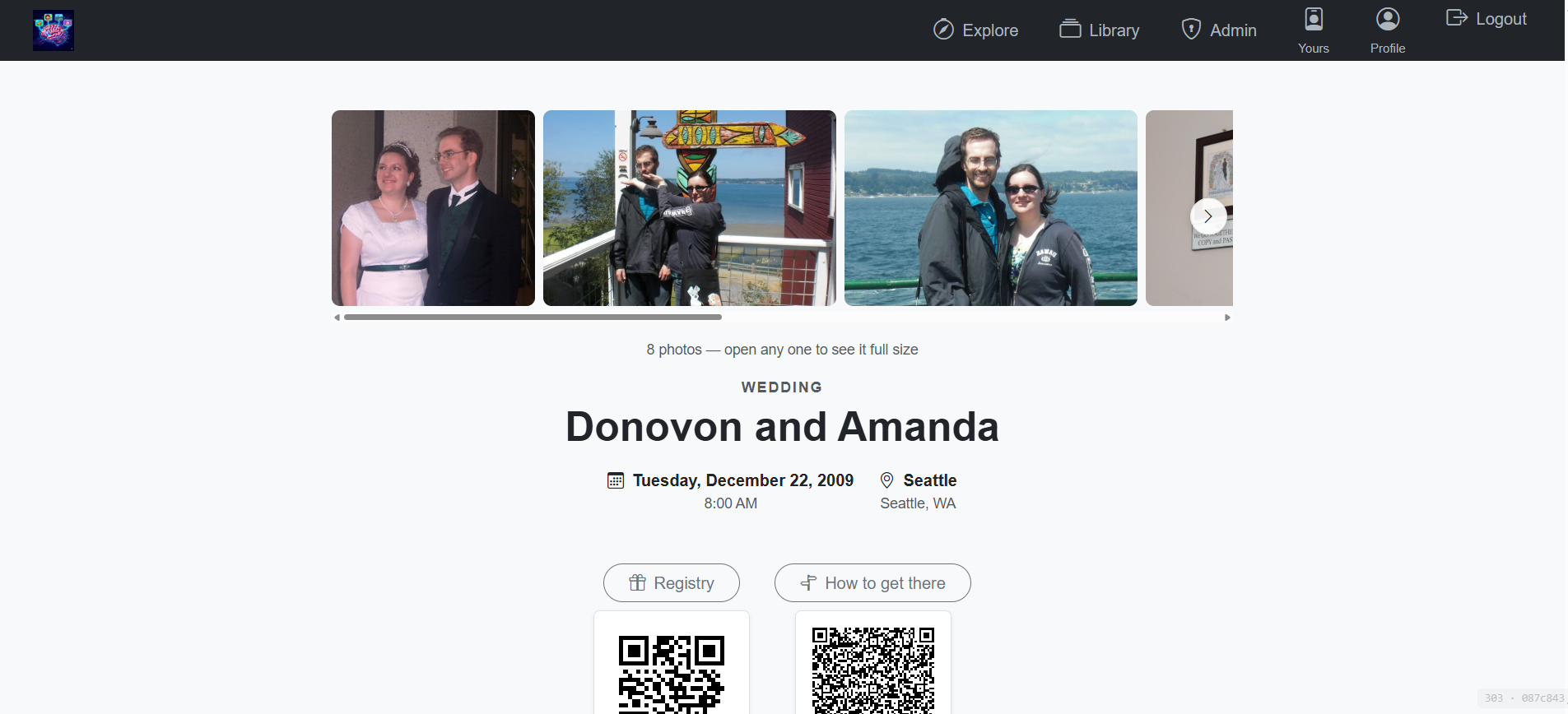
Everything in one place on the day: who is who, what happens when, and a wall guests add to from their seats.
Memorials
Somewhere to keep someone's story in their own words, told a piece at a time the way you would tell it to a friend — and for the people who knew them to add what they remember.
- A story, not an obituary. Write it as a conversation, with photos and video along the way.
- Memories from everyone. Family and friends add their own stories and pictures from their phones.
- For the service. Put it on a TV at the gathering, and it cycles through the photos and the words people shared.
Step into a living memorial and get to know Daniel through his story.

A life told in order, with the memories friends and family added along the way.
Not only for people
A memorial can hold the history of anything that mattered — a gaming guild, a club, a group of friends who were there for each other.
Relive the adventures of the legendary EverQuest guild The Weary.

Guildmates add their own screenshots and stories of the nights they remember.
Volumes and experiences
The two kinds of story the rest is made from.
- Volumes are the people, pets and places in your life, each with a timeline of their own. Link one to an occasion and its story shows up there, in date order.
- Experiences are moments in history told from the inside — read one through as it happened, then see later how much stayed.
Articles
Memory in film, music and story
How memory actually works
What there is to study
20 things to read and be tested on, free and without an account.
- Subject Amelia 7 moments · 6 facts
- Subject Anne 6 moments · 4 facts
- Experience Apollo 13 Two days out from Earth, an oxygen tank explodes and a Moon landing becomes a rescue. 7 moments · 8 facts
- Subject Bach Most of my life has been spent in churches and courts… every week, new music to write. 9 moments · 3 facts
- Subject Benjamin Remember that improvement—of oneself, of one’s community, of one’s nation—is a lifelong pursuit 9 moments · 4 facts
- Experience Chernobyl Disaster The catastrophic nuclear accident that occurred on 26 April 1986 at the Chernobyl Nuclear Power Plant. 5 moments · 4 facts
What's new
Small changes as they land. The longer pieces are at the top of the page.
A game of match
A flip-card memory game built from everything shared publicly in the library. One half of each pair is a portrait and the other is the name, so what you are remembering is which face goes with whom - and every pair you find turns into a link to that subject. Six, eight or twelve pairs, no account, nothing kept.
A page listing what there is to study
Every subject and experience shared publicly now has one place to browse them from - what each one is, how much there is to read, and the opening of its first moment, so you can tell whether it is for you before opening it. The front page shows a few; the full list is at /what-to-study, and it keeps itself current rather than being whatever was true the last time the site was built.
RSVP on the page itself
Guests can answer an occasion right where the invitation is - yes, maybe or no, how many are coming, and a note only the host reads. Answers can be changed later, and the host sees the count without chasing anyone. No account needed, if the occasion allows posting without one.
Choose when you are tested
A studied batch used to come back exactly one week after you studied it. Now you pick the gap when you save it - five hours, a day, three days, a week or two weeks - so a quick review and something you really want to keep can be spaced differently.
Put an occasion or memorial on a TV
One button turns the page into a slideshow for a screen in the room: photos, the story, and messages as guests post them. A settings panel on the screen sets how fast it moves, what it shows, and whether captions appear.
A page that explains the parts
Occasions, memorials, volumes, experiences and subjects now have one page explaining what each is for and how they fit together, rather than each explaining itself somewhere you had to already be.
Guest photos as a gallery
An occasion's guest wall can switch to a grid of just the pictures people posted, instead of scrolling past every message to find them.
Pages can say who made them
A memorial, occasion or volume can show its creator's name, and each one has a switch to turn that off - a memorial is often meant to speak only for the person it is about.
Choose the name you appear as
Accounts have a display name now. It is what shows when you create something or post on a guest wall, in place of the email address you sign in with.
For any questions, partnership inquiries, or support requests regarding MemoryGame, please contact our team at:
Copied to clipboard! ✓